

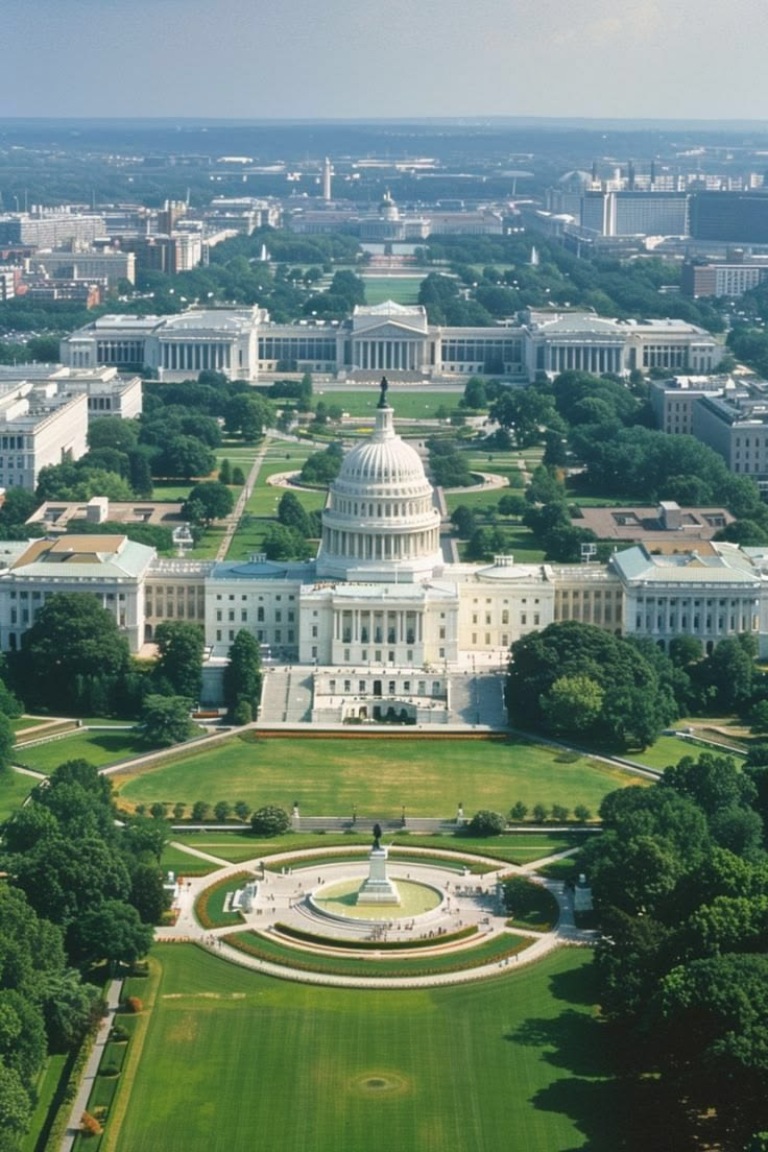

Why Embassy Corridors and Institutional Stability Create a Structural Floor for Luxury Real Estate
By Kimberly Casey | Washington DC Luxury Real Estate Expert
Every global capital carries a premium.
In London, it is legacy and finance.
In Paris, it is culture and preservation.
In New York, it is capital markets.
In Washington, DC, it is power.
Over decades advising buyers, developers, international investors, and estate-level families, I have observed something that is rarely written about but deeply understood by sophisticated capital:
Proximity to influence stabilizes property values.
I call it the Political Power Premium — and in Washington, DC luxury real estate, it is real.
What Is the Political Power Premium?
The Political Power Premium refers to the structural value embedded in properties located near:
- Federal institutions
- Embassy corridors
- International organizations
- Policy centers
- Global lobbying and legal infrastructure
- Major philanthropic and think tank headquarters
Unlike markets tied to singular industries, Washington’s economic foundation is institutional.
The city houses:
- The United States federal government
- The Supreme Court
- The World Bank
- The International Monetary Fund
- Over 175 embassies
- NATO mission offices
- Defense contractors
- Global law firms
- Policy think tanks
These are not cyclical employers.
They are structural anchors.
When capital flows globally, stability commands a premium.
Embassy Corridor Homes: Built-In Demand
Neighborhoods such as:
- Kalorama (20008)
- Massachusetts Avenue Heights
- Forest Hills
- Wesley Heights
- Select Georgetown corridors
- Parts of Spring Valley
are home to embassy residences and diplomatic leadership.
Embassy corridor homes benefit from:
- Long-term leasing demand
- High security standards
- Stable diplomatic tenant pools
- Discretion in transactions
- Limited turnover
This is one reason luxury properties in these corridors frequently outperform broader market softness.
Even when residential sentiment fluctuates nationally, diplomatic infrastructure continues.
Foreign governments do not “time the market.”
They allocate strategically.
That allocation supports values.
Billionaires Follow Power
It is not accidental that high-profile figures such as:
- Jeff Bezos
- Mark Zuckerberg
- Peter Thiel
- Eric Schmidt
have established significant presence in Washington, DC.
These individuals operate at the intersection of technology, policy, regulation, and global influence.
They understand something many overlook:
In a world increasingly shaped by regulation, antitrust oversight, defense spending, and geopolitical tension, proximity to policymakers matters.
Ownership in Washington is not simply residential.
It is strategic positioning.
When billionaire-level capital enters a submarket, it reinforces global perception.
And perception influences valuation.
Why Washington Is Different From Other U.S. Cities
Most U.S. cities are driven by industry cycles.
Silicon Valley depends on tech valuations.
Houston depends on energy.
Miami depends heavily on migration and capital inflow cycles.
Washington, DC depends on governance.
Government does not relocate.
Embassies do not relocate.
The Supreme Court does not relocate.
That permanence creates resilience.
Even during political debate or national tension, Washington’s relevance intensifies rather than diminishes.
Institutional presence provides:
- Employment stability
- Defense spending continuity
- International conference traffic
- Diplomatic infrastructure
- Policy-driven capital flows
That structural depth supports luxury real estate demand.
The Security and Privacy Factor
Embassy corridor luxury real estate also benefits from enhanced security standards.
Buyers in these neighborhoods often prioritize:
- Setbacks
- Perimeter privacy
- Interior garages
- Controlled access
- Limited commercial adjacency
- Mature landscaping
- Discretion
The same characteristics that appeal to diplomats and international ministers appeal to high-net-worth private buyers.
Security and prestige reinforce one another.
Washington DC Investment Property: A Stability Thesis
When evaluating Washington DC investment property — particularly in prime submarkets — the underwriting thesis differs from other cities.
Investors here analyze:
- Institutional adjacency
- Embassy demand
- Regulatory durability
- Long-term liquidity
- Limited new land supply
- Height restriction constraints
The Height of Buildings Act restricts vertical overdevelopment.
Historic preservation overlays protect architectural integrity.
Limited land plus global relevance equals structural scarcity.
Scarcity supports pricing floors.
Political Proximity and Pricing Behavior
In my experience advising on more than $1 billion in transactions, properties located within corridors of institutional influence often demonstrate:
- Faster absorption in luxury tiers
- Stronger cash-buyer presence
- Lower volatility during macro slowdowns
- Higher international inquiry
- Greater resilience in estate-level brackets
Luxury pricing in Washington is not purely lifestyle driven.
It is policy adjacent.
That adjacency matters.
Global Capital Seeks Political Anchors
In periods of geopolitical volatility, capital does not retreat — it repositions.
Family offices, sovereign wealth investors, and multinational executives increasingly evaluate political capitals as long-term hedges.
Compared to other global cities, Washington remains:
- Undervalued on a price-per-square-foot basis
- Highly relevant geopolitically
- Structurally supply-constrained
- Supported by diplomatic infrastructure
That combination is rare.
Why This Is Often Overlooked
Most real estate coverage focuses on:
- School districts
- Restaurants
- Walkability
- Design trends
Those matter.
But for estate-level and international buyers, proximity to influence is often the unspoken driver.
They are not buying solely for lifestyle.
They are buying for positioning.
The Future of the Political Power Premium
As regulatory oversight, global trade negotiations, defense spending, and digital governance intensify, Washington’s relevance is only expanding.
Technology leaders now recognize that Washington shapes their operating environment.
Global business increasingly intersects with policy.
That intersection reinforces DC’s strategic value.
The next decade will likely see:
- Continued international investment interest
- Expansion of embassy modernization
- Increased billionaire presence
- Sustained luxury demand in institutional corridors
Political capitals endure.
And in Washington, DC, that endurance supports long-term property valu
About Kimberly Casey
Kimberly Casey is a Washington DC luxury real estate expert, third-generation Washingtonian, and Georgetown resident of more than thirty years. With over $1 billion in career sales, she advises international buyers, developers, family offices, and estate-level clients across Georgetown, Kalorama, Wesley Heights, Spring Valley, Bethesda, and McLean estate corridors.
Her advisory approach blends financial modeling, geopolitical awareness, and hyper-local market intelligence — positioning clients strategically in the nation’s capital.